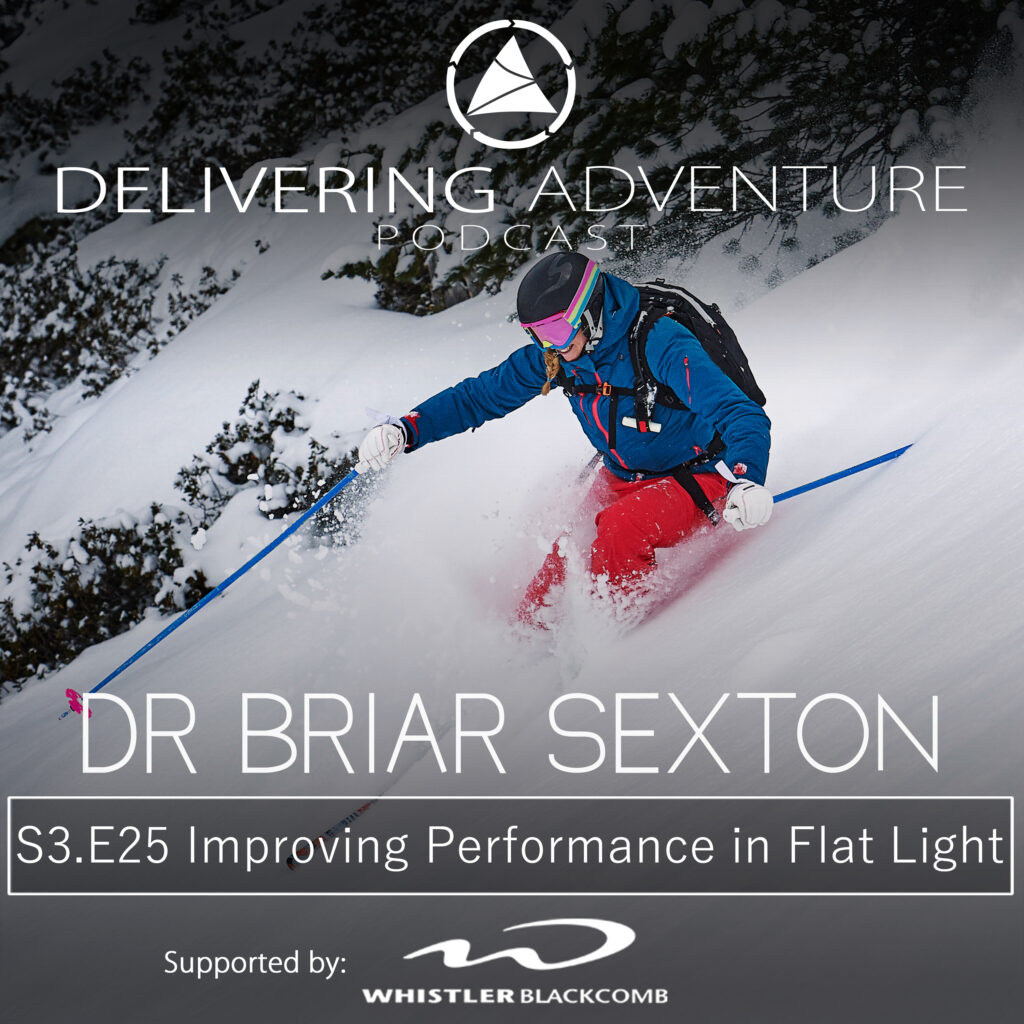
Improving Performance in Flat Light with Dr. Briar Sexton
How can we reduce our vulnerability in flat light? If you work or travel in the snow, especially above the treeline, you have likely encountered flat light. Flat light, also known as a whiteout, is an atmospheric and optical phenomenon where the light is bounced in every direction. This removes shadows and contrast which can make terrain appear featureless.
Flat light is the result of cloudy or foggy conditions and is most prevalent where we don’t have any features such as trees to give us reference. This can lead to a loss of depth perception and disorientation.
In this episode of Delivering Adventure, Dr Briar Sexton joins Chris and Jordy to discuss some of the strategies that we can use to better manage in flat light.
Dr. Sexton is a Clinical Assistant Professor at the University of British Columbia and currently practices comprehensive Neuro-Ophthalmology in Vancouver, British Columbia. Dr. Sexton was born and raised in London, Ontario, and completed her undergraduate degree in Biology at McGill University and her medical degree at the University of Western Ontario. She is based in Vancouver, BC.
Key takeaways:
What is flat light and how does it affect us?
What Flat Light is: Flat light affects our ability to accurately judge contour and texture changes. This can increase our vulnerability by causing us to become disoriented due to a loss of depth perception. This can lead to a loss of balance and ultimately to a loss of confidence.
How it Affects us: Because flat light causes a loss of depth perception, it can lead to us being surprised when the terrain changes and we don’t expect it. Losing confidence can further increase our vulnerability by putting us in a more defensive position. It can also lead to nausea and a feeling of motion sickness.
People Most Affected: People who are more likely to be impacted by flat light include people who may have cataracts, anyone who has any form of visual impairment, anyone with underlying balance disorders.
How can we manage in flat light?
Being Stronger: Someone who has better core strength and conditioning is more likely to recover from a sudden loss of balance that can lead to a fall.
Finding Points of Reference: This includes travelling beside things like trees which can help us to better judge our speed and position. Following someone else, which can do the same thing.
Slow and Loose: Slowing things down and staying loose can also increase our ability to adapt to terrain changes that we may not be able to anticipate.
Lens Selection: Using good lenses and keeping them dry is essential. Good lenses for flat light are ones that have high visible light transition. These include lenses that are rose, pink, amber, orange and persimmons. If you are looking for one lens that gives you the most range, it is going to be the rose lens.
Experience Matters: If someone has never experienced flat light conditions, they may not be able to appreciate how hard it can make things.
Guest Bio
Dr. Briar Sexton is a Clinical Assistant Professor at the University of British Columbia and currently practices comprehensive Neuro-Ophthalmology in Kitsilano (Vancouver), British Columbia. Dr. Sexton was born and raised in London, Ontario, and completed her undergraduate degree in Biology at McGill University and her medical degree at the University of Western Ontario. Upon graduating from Western Ontario, she went on to complete her residency in Ophthalmology at Dalhousie University, followed by a fellowship in neuro-ophthalmology at the University of British Columbia.
Dr. Sexton has a special interest in concussion, migraine, traumatic brain injury, and post-concussion syndrome. While not in the office, Dr. Sexton enjoys traveling, skiing, and reading.
Guest Links
Dr Briar Sexton: Website
Follow or Subscribe
Don’t forget to follow the show!
Share & Social Links

Dr. Briar Sexton